Visits

Tuesday, October 26, 2010

2010 - Boss SD-1

This one came to me nice n' cheap. I bought it at a 2nd hand dealer in the city. $65 and practically brand new.
What do you do with cheap pedals? Mod them of course!

I'd read that this is basically a tube screamer with some parts changes.

Stock this pedal is pretty decent sounding, a moderate overdrive on full and a nice clean boost on minimum.
Unfortunately the filter caps on the input remove a lot of bottom end. So rather than add some punch, it cuts some of the guts out of it.

The first thing I did was to do the SD808 mod and turn it into a tube screamer.
Basically it's just changing one cap, removing another as well as a diode in the clipping stage.
What this does is make the clipping asymmetrical and alter the tone control.
To my ears and playing style, it wasn't much of an improvement. It still lacked the bottom end.

The next mod I did was the bass mod.
This is done by simply bridging two components, a capacitor and a resistor.
It was three weeks before I got around to testing it out, but when I did, the pedal was a whole new beast.
The gain still isn't much really, but that's OK I like it like that. The bottom end is nice and big, though a little muddy as there's a slight octave effect on some notes. But for the tone I'm after, this is almost perfect.
Placed in the FX loop of the Delta Blues, the pedal is responsive to dynamics and has the added bonus of acting as a master volume, though the extra gain from the preamp means that the pedal never completely cleans up.

I may end up doing some further mods to the clipping section and maybe change out the opamp for something else. But for now I'm pretty happy with this cheap pedal that cost about $1 and 15 minutes of my time to get close to what I want out of an overdrive.

Not too smooth, and just a little raspy.

Saturday, October 9, 2010

1993/94 - Sovtek Big Muff Pi

Long long ago in a land far far away (660km if you want this definition of far.) I learned to play guitar.
Most of what I knew of FX was what my friends had or was built into school amps.
The guitar store in town had a couple of cheap Arion pedals, but they were just overdrive and distortions.
I think I owned the overdrive for a while, but it was pretty tame so I just relied on the sound of whatever amp I was using at the time.

I was about 14 or 15 when I got into the Smashing Pumpkins (Siamese Dream) and was an avid reader of guitar magazines. In one, I think it was Guitar Player, there was an interview with Billy Corgan where he talked about an EBow(what they hell was an ebow?) and his distortion sound.

The distortion was the Big Muff. What a funny name I thought. I was interested right away. I had to have one. The only problem is that they'd been out of production for years and weren't easy to find. (Remember this was pre-internet and no ebay). Around this time I'd become a regular at a music shop in the larger neighboring city.
When I had nothing better to do I'd just hang out there and more than likely was considered a bit of a pest. In their front counter they had these big army green boxes that looked like they belonged in a cold war bomb shelter. These boxes turned out to be the first incarnation of the rebirth of the Electro Harmonix line (I had no idea at the time). They shipped in wood containers labeled in Cyrillic letters and just oozed cool.

If I remember correctly I purchased the Big Muff at the same time as I bought the JCM800. It took some months to pay off but when I got it home, I played all the time. This was my main distortion for years. Big and fat and dirty. It was all I knew of distortion for a very long time. And it was awesome!

I ended up parting ways with this pedal at the same time as my Classic 50. It was lost to me for all intents and purposes. But.... around 2005 I got it back! My friend that I'd sold them to when I left town, just gave this and the Small Stone phaser back to me.

At the time I was playing synth and a bit of guitar in a band and the return came when I was broke and in need of some FX. Unfortunately the reunion wasn't all that happy. They were a bit broken. As a teenager I thought it was indestructible. This pedal took an absolute battering between shows and rehearsals. We'd all thought we were punk rock and beat the stuffing out of our gear, I was probably the worst though. I managed to shatter the plastic input on the board. This was something I'd forgotten about until the return. Upon opening it up to fix the battery lead, I re-discovered some of my earliest solder work. It wasn't pretty! It was functional though and I vaguely recall fixing it with whatever the local Tandy had in stock, which was a chassis mount open stereo socket. I ended up re-repairing it with something closer to original spec and it works just fine.

Since getting it back I have struggled with the tone. It's a finnicky pedal in regard to the load that it needs to sound good. Humbuckers and high impedance pickups are a no-no. It just doesn't sound any good with it.
My only guitar that sounded ok with it was the Teisco. The Surfcaster and Les Paul just don't sound any good. So the Big Muff has lived in a drawer more often than it has on my pedal board. I pulled it out again the other day to play with my new amp and guitar. Guess what? It sounds great with the Mosrite and the Peavey Delta Blues!

The guitar has the right electrical characteristics and the amp can handle the low end hump!

So there's another pedal dusted off and ready to play

Now there's not much I recall about the purchase of the small stone, I suspect I bought it at the same time as the BMP, or at least so close together as makes no difference.

The Small Stone is pretty famous, makes a nice swoosh and I like it for the very slow LFO. It does have a bit of an issue with a volume drop when engaged. I modded it to stop this, but the mod changed the tonal characteristics, so one day I'll just change it back.

I've actually built one of each of these pedals for friends.

They were both tricky builds in a way, it took a while to get them working well.
The Small stone clone also had the "univibe" mod, nothing at all like the univibe, but allows the shifting of the phase degree by switching some capacitors. It was a bit quiet, so I added a small preamp booster to the input which overdrives the phaser circuit and creates a small stone phase tone with a twist.

I liked the sound quite a bit, and the last I heard, the guy I built it for was pretty happy with it too!


.

2009 - Fulltone Mini Deja Vibe2

For years I wanted a univibe clone. Always baulked at the expense.
All of the clones cost a heck of a lot. There are a lot of clones too, so which one to pick?
Obviously I eventually settled on the Fulltone, but it was an almost agonising decision.

The MDV2 costs RRP $565 or there about the last time I looked.
No way was I going to pay that much for what is essentially a glorified phaser.
So I started looking further afield...

USA prices were much more reasonable, and our two currencies were nearly at a ratio of 1:1.
I'd sold a bunch of lesser pedals and had a few $ sitting in my paypal account waiting to be put to use.
There was a shop in Melbourne that had one in stock, but when I went to try it out the sales guy told me it'd been moved to another store on the outskirts of the metropolitan area and wasn't coming back for at least a month. Since my effort to try one out in person was thwarted, the only thing to be done was hit the internet.

Not a heck of a lot of information was available on this unit. Not many demos either.
So it was a bit of a leap of faith when I decided to buy online. It was a little over half the Aussie RRP including postage.

So I bought it and then had to wait....
It seemed to take ages to get here, but in reality only took a week.
The unit is fairly large, with considerable weight.
Nice and creamy coloured and the PCB is compact and nicely laid out.
It's been modified from the original to allow a higher and brighter output if one chooses.

When I finally had the opportunity to play it, I had mixed feelings.
The wobble and whoosh was nice, but on my DI rig and Epiphone amps it seemed to drop a lot of bottom end off when engaged. The MDV2 does the lopsided swooshy throb thing very well. Vibrato mode sounded quite subtle but more of just an add on option rather than a useful effect. I liked it, but wasn't really all that impressed. So for most of the time I've had the pedal, it has remained in a drawer and potentially facing the auction block. Also the phase on the lowest speed almost sounded as if the effect was off.

That was until yesterday....

Yesterday I dusted it off and plugged it into the Delta Blues, oh boy what a difference!
I swear there's something about that amp that maxes everything sound good. I'm not saying magical or mojo, but something fundamental on the electrical level. The difference I suspect is the input impedance.
On a stock Epiphone Valve Jr, the input impedance is about 100k and on the Delta Blues spec states 470k.
The end result is the Delta Blues has a greater frequency range on input and your guitar and effects can drive the valve stage a little harder (The Valve Jr is easily modified to rectify this).

The effect that this had on the univibe clone was an overall improvement in sound quality. The bass cut I'd experienced before has gone away. The phasing at low speed is much more pronounced and the pitch wobble in the vibrato mode is now clearly audible. In fact on both settings, the depth control doesn't need to be on maximum. The effects come through nice and clear, great on clean and distorted alike!


In all, I'm glad I didn't part with the MDV2. It's definitely a keeper.

Monday, October 4, 2010

2007 - Korg MS10

The MS10 is an under rated synth, though considering the specs, a bit expensive for what you get.
But what you are paying for is a bit of hype dripping from its bigger brother. Don't get me wrong, I love this synth. It oozes bass and the filter makes a brilliant guitar distortion.

Actually if you're after some interesting guitar tones, the MS10 is great for using as a wah and a filtered tremolo!

The thing that makes it nicer than some of the MS20 filters is that, in the MS10 the diode clipping stage is before the filter. In the clones and later model MS20's the clipping section comes after it and the sound is totally different. I A/B'd the MS10 with a Frostwave Resonator. While both sounded good, the distortion on the ms10's filter was more pronounced and aggressive.

What's clipping? That's a fancy name for distortion.

When you distort your instrument through a pedal, more often than not, the tone controls come after the distortion stage. This is for a reason, it generally sounds better that way (not a rule, but it does work nicely).

The oscillators are the typical Korg sound.
My favourite is the Square wave with a bit of Pulse Width Modulation. It adds a stringy pad like bottom end that sounds great on pretty much every synth out there. The MS10 might not have a whole lot of range, but it does it's thing nicely. Not too many parameters to get your head around and it's great for learning how synthesis work. For the most part you don't even need patch leads as the common options are pre routed via the knobs along the front panel.

Mine had some mod on it when I made my purchase, but I can't actually recall what it did.
I ended up changing the mod to enable audio frequencies from the LFO, which in turn allowed a sort of FM synthesis. I also added a 2nd audio output and a Ken Stone passive ring modulator. This came in handy when I was selling it on later down the track.

Mostly I used it for standard basses, leads and the odd laser gun sound. Typically I'd control it via a Frostwave MC-1. Calibrating it was a pain. The MS10 has a tendency to drift off the calibration for the keyboard and the trim pots were overly stiff and would often go back to the pre-adjustment position.

I ended up selling it on ebay. Shortly after selling it, the new owner destroyed the filter cutoff and asked me to fix it. As a result of that repair, I ended up building several other synths and joining a band with him. Incidentally this also led to being exposed to the wonderful world of Man or Astro Man?

As much as I like the MS10, I don't regret passing it on. I still have other synths that do what it does and if I do get nostalgic, I only have to ask to borrow it.


Specifications

    * Polyphony - Monophonic
    * Oscillators - 1 VCO with mixable white/pink noise generator
    * LFO - One LFO w/ multiple waveforms
    * Filter - One lowpass VCF
    * VCA - ADSR with Hold
    * Keyboard - 32 keys
    * Arpeg/Seq - None
    * Control - CV/GATE
    * Date Produced - 1978

Wednesday, September 29, 2010

2005 - Digitech Bad Monkey

In some circles this pedal is over hyped, in others it's not appreciated.
People seem to think it's just another tube screamer clone. And it is, even though it has adjustable bass and treble, rather than just a tone control.

They're cheap, which is a bonus, they sound good out of the box. Also good, since the components are surface mount and not easily modified. There are some "secret" bass mods out there, but if you're handy with a soldering iron and can do simple R/C calculations, you'll be able to do the mod for yourself.

I have two, mine are stock.
One was made in USA and the other in China.
There are no sonic differences to my ear, but there are some visual differences.
Namely the colour of the capacitors and from memory, the PCB's might be a different colour too (it's been a few years since I opened them up).

The sound of them is a mild overdrive to a very moderate distortion. Two in series is pretty good for a metal distortion tone. The distortion never cleans up completely, so they're not any good as a clean boost.
It could probably be changed, but the traces and parts on the board are tiny and I doubt worth the effort.

Even though this is an overdrive pedal, that's not really what I use it for.
It turns out that Digitech have incorporated into their pedals, a very nice DI, complete with the correct EQ to record the guitar clean or distorted through the "mixer" output. It balances the tone and simulates the reactive load of a speaker. I use it all the time when noodling with my headphones on or recording guitars when I can't mic them up (which is most of the time). Actually I like using the Bad Monkey in bypass mode to act as a buffer and signal splitter, so that I can record the unaltered guitar tone through the desk as well as recording an amp. That way I can change my tone/fx later and if I want to re-amp the signal for re-recording "live" effects.

You should be able to pick up a bad monkey for about $50AU.
While there's nothing ground breaking going on, they offer some very handy tools for the recording guitarist.
I've even used them live when there weren't enough Mic's available for the whole band!

Monday, September 27, 2010

2010 - Peavey Delta Blues 115

Classic 50 head, with custom decal from a beer poster.
The last piece in the puzzle has been aquired.

About 12 years ago I owned a Peavey classic 50 head.
It was one of the nicest amps I'd ever owned. Unfortunately it had to be parted with as I was moving 700lm to a new city and the need for cash was greater than the need for a big valve amp.
I didn't have a speaker cab for it and it wasn't all that long after I'd injured the tendon membrane in my left hand and wasn't allowed to play guitar for a year. That was all a bit sucky and it left me ampless for a long time. I did have a BOS Gt-5, but it wasn't the same thing. So for years I'd regretted the unavoidable sale of the Classic 50 and have been trying to buy it back from the friend who I sold it to for the last 5 years. He won't budge. I've had a number of small amps in the years between then and now, but could never really justify spending a large sum of cash for an amp when a: I didn't have a car and later b: I didn't have a band.

I'd been planning on picking up a Classic 30 combo for a long time, but every time I'd found one, I had no spare cash. After getting the Mosrite a few weeks back I discovered that the classic series had two more amps in the line. The Classic 20 and the Classic Delta Blues. Since the 20 has no reverb, it was of no interest to me, as that directly affects my playing style. I like big gobs of reverb. I discovered the Delta was basically a Classic 30 with the addition of tremolo! Well, that was it. I was on a mission. I had to have a Delta Blues 115.

It didn't take long. I found two on ebay within a week of each other. One was in Brisbane and was a bit more than I wanted to spend, once couriers were factored in. Also i had no guarantee that it would have arrived in working order as the guy had not packing material. I let the auction go, only to find one for sale a mere two suburbs away!  I was the only bidder, so naturally I won the auction (all with the blessings of my dear lady). I took my $2 shop trolley along on the 109 tram and collected the amp. The guy I bought it from was really nice and we had a good old chat about amps and kids and whatnot. He even helped me tape the thing solidy to my trolley for the trip back home.

I got it on the tram in the opposite direction, fortunately it wasn't overcrowded and the trip up the hill took about 10 minutes. Not bad for peak hour.

It's not the heaviest am in the world, but I was glad to have the trolley as I had a half kilometer walk with it after the tram ride. Time was ticking and it seemed to take forever to get the thing home safely and fired up.
But get it home and fire it up I did.

I set it up in the middle of the lounge, switched it on and went for a cup o tea.
After letting it warm up a little while I was ready to play. I cracked out the Mosrite and got to playing.
The clean tone from the Delta Blues is big and rich and um.... I can't think of any other superlatives. suffice to say, it's particularly nice! Almost as good as the Classic 50 of old.

I've read a lot of reviews on the amp and have to agree about the dirty channel being a little disappointing.
Not so much disappointing, but not as inspiring as the clean channel. The lead channel has this bass cut which just makes the Delta Blues sound like and asthmatic bulldog. The amp has a 15 in cpeaker damn it, gimme some bass with my distortion. Fortunately it also seems to be a fairly simple mod to rectify that issue, if only one could overcome the fear of death at high voltage.

The reverb is pretty nice but is lacking a little. At maximum the reverb is just enough. But I want to gave the option to have far too much. Ok I can achieve this with an FX unit, but I don't always want to carry the m13 around. The schematic shows a simple 4558 opamp circuit which can be upgraded easily enough to get more gain and higher headroom. I've got some spare OPA2134's floating around which should take care of that rather nicely.

My last beef with the design of the amp is the tremolo, I've tread that there is a bit of a volume drop when it's engaged. It turns out that mine does it too. You can manage it if the depth knob is no more than 5, but then you don't have the full throb of a tube amp wit tremolo. The implementation is very basic, and I suspect it is to keep the cost down. It's much easier to create a tremolo effect via optical circuitry than it its to have a safe valve bias tremolo effect. 1/2 of the 4558 seems to be feeding the tremolo circuit and should prove fairly easy to correct for the slight volume drop.

I do plan to modify the amp some time down the track, but for now am happy as is and can augment it's function with an effects pedal or two.

The boost switch seems to get a lot of bad press. From my limited experience on the amp I kinda get it, but when I was playing my Jim Dunlop Octavio through the Delta Blues, the mid boost was actually quite beneficial in bringing out the dirt and octave up produced by that effect.  I've only used one pedal with it so far, but the Octavio sounds fantastic through this beast.

A couple of days after buy the amp I decided to try adding a master volume to the FX loop.
Worked a treat, I was now able to reduce the volume to something sensible for playing in a built up area.
I have my suspicions about the pot that I used, as the volume drop was a lot more than I had anticipated.
Since I broke one of the tabs off the pot this morning, I'll be getting a new one in there instead. Another option would be to use a rotary swtich with different values from 100k to 2.2m(which is supposed to be the return impedance).

I played around with it some more tonight, ran it on low volume, to keep the peace. The line 6 m13 really sounds great with this amp. I just went with it placed in the FX loop and discovered the reverb on the Line 6 is actually nicer than the real deal spring tank (go figure). This was mostly down to the level of noise the analogue version introduces.

After this I decided to run all of my guitars through the amp.

First up was the Surfcaster. It was light and cheerful, not particularly driven, which I found surprising. The lipstick pickup sounds great with this amp, as does each coil of the Seymour Duncan P-Rail.

Next was the Teisco Kadet. What has consistently been the quietest guitar on my other gear turned out to be a big fat tone machine! It sounds thick and powerful and its made of plywood!

The 3rd guitar I tried was the Guyatone LG127-t. Similarly beefy in tone to the Teisco, but it was a little quieter and the tone was more balanced than the others.

The 4th guitar... you guessed it was the Mosrite Ventures.
Very country. A lot more treble than the two vintage guitars, but thicker sounding by far than the Surfcaster.
I twanged away on it for ages, til the phone rang and I realised that my whole leg had gone to sleep when I went to answer it.

The amp does get very hot above the power valves. Too hot to touch. I think its normal, but could do with a little research. Overall the amp has excellent tone and volume, even with the mid range EHX valves on board.
In a year or so I might consider the mods and change the valves for better spec. I'm glad I bought back into the classic line. It's a great sounding amp, and with the right guitar, very fendery.

Sunday, September 26, 2010

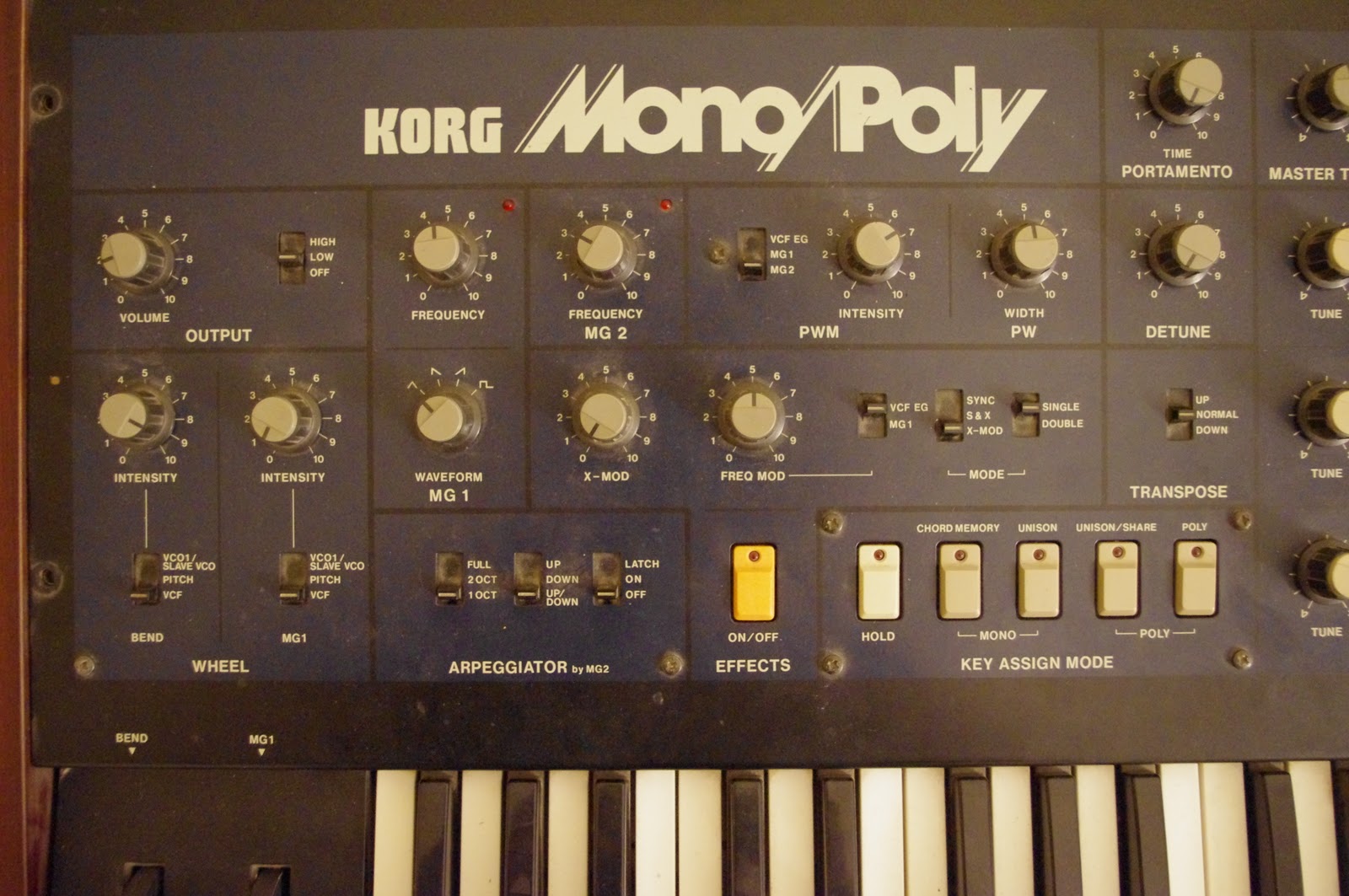
2010 - Korg Mono/Poly

It's mine, all mine, finally mine, mine, mine!

Uh.. yeah. I've been after this synth for a long time.
Not the model, but this actual synth.
When I bought my AN1X it cost me maybe $500.
On the stand next to it was a Korg Mono/Poly for over a grand.
Everywhere I went, online and in meat space, I was told that this synth was not so good.

Well... I thought it looked cool and despite the criticism it's received, I think it sounds great with loads of functions!

This particular unit was found by a friend of a friend at Canberra Tip. That's right, the rubbish dump.
Gut Shot
He was working at the recycling centre at the time and basically had the pick of the stuff that came through before being made into land fill or sold to the public. So it wasn't covered in rubbish and bird poo.
The Mono/Poly was in 100% working order too. Whoever threw it away probably had no idea on how to use it. My buddy had told me the story and I offered a sum of money, but that was rejected flatly.

Sometimes patience pays off.

Portamento Control
A few months ago my old friend came to visit, and I casually mentioned the Mono/Poly again and he told me it was sitting in a cupboard back in Canberra and hadn't been used for years. After a little more conversation it turned out that the owner of the Mono/Poly was into collecting Starwars and Manga paraphernalia. I'd sold off my Starwars Lego, but still had a box full of akira figurines, from back when I was into that stuff.

So we had the basis of a trade. My old house mate was the intermediary and brokered the deal.

The deal was agreed to and a few months later he turned up at my door with a bucket full of old videogame console parts and a rather smelly Korg Mono/Poly.

It smelled like it's been hanging about forgotten, at 9th Ward before it burned down.
There's a smell that every synth I ever worked on gets, when it has been owned by a smoker.
Especially smokers who don't go outside to puff. It's pretty foul, but does tend to go away after a while.

Anyway I got the synth indoors, tried to ignore the smell and plugged in my headphones.

It's a funny old synth. My daughter made her first scifi laser sounds on it at 14 months of age! The portamento seems to be a little off, as in I can't switch it off for each voice. The filter is on a chip as opposed to the MS10 I used to own, which was a sallen key driven by a proprietary OTA style chip. The sound is pretty similar and will self oscillate and has a nice resonance. The poly mode is kinda funny, it can do chords, but not really in the classic sense. 

As yet I haven't had much time to play with it, but I did open it up and take some photos
There are so many knobs, it looks like it'll be a real pain to get in there to clean 'em all and reassemble the board.  Not much dust inside it either, though I found an unidentified piece of hinged metal and a dead moth.

Time to dig out the midi-cv converter and play around.