Visits

Showing posts with label Bad Monkey. Show all posts

Friday, March 14, 2014

Simulating Pickups & Splitting Signals


SHO Clone & Pickup Sim


Last weekend I decided to make Jack Orman's Pickup Simulator. I've had the parts collected in a little bag for a long, long time. It's a really simple circuit, and one that I really should have built earlier (say back in 2009).

The purpose of the Pickup simulator is to deal with certain pedals that prefer to be fed straight from the guitar and not through the buffer of another pedal (EG: Fuzzface, Big Muff, Octavio).

I didn't have the Mouser 42TL019 transformer on hand, but I did have the Mouser 42TL018 which has a similar enough primary coil value.

The pickup simulator works really well, but that's not the only reason I wanted to make it.

I usually record in stereo with one effected and one dry track. The drawback with this is the guitar had to go into a pedal that had stereo outputs. Which by default, introduces a buffer for each channel.

Since the schematic shows that the transformer can be tapped to obtain two different impedances, I figured it should also be useful in sending the signal to two destinations. Even five, if you don't mind a bit of transmission loss in the secondary coil.

Both of my guesses turned out to be correct.

Splitting the primary gives the best signal, and improved the character of the guitar signal significantly when compared to the buffer split.

One side of the stereo pair goes through effects, the other simply goes into an analogue amp/speaker simulator. It was on the clean side that I noticed the most improvement (Especially on the Bass VI).

This is a no frills tool, but it has the potential to bring some life back into otherwise lifeless sounding effects.

This has been one of my cheapest builds, and its probably the simplest. I wish I had invented it, this should really be available as an off the shelf product.

Until next time.

T.A.P.O.R.


Sunday, June 30, 2013

Rediscovery of Distortion Pedals

If you've read my posts from late last year you'd know that I was working on converting my old tin shed into a studio & workshop.

Now I wasn't exactly flush with cash for this project and had to make do with what I had available to me. My studio is divided into two parts. 

A gear room and a recording booth.

The booth works fairly well. Nobody can hear my dodgy acoustic guitar playing or my lousy singing outside of the shed.

Even playing electric guitar I can get a decent tone to "tape" for clean sounds. But the problem I have is that if I want distortion from the output tubes (my favourite kind) I can only really do that during the day, even with my 5 watt amps.

I know for a fact that it can't be heard in my own home, which is just about the same distance as my closest neighbours to the recording room. So in theory I could play as loud as I want inside with the gear that I have, but I just don't feel comfortable with it.

The obvious thing to do of course, was use distortion pedals and turn the volume down. Sure, its obvious now, but I didn't even consider it until now.

I have several distortions and fuzzes, but I think maybe that I was a little prejudiced toward achieving my favourite tone.

So last night I had a hankering for a wee bit of grit and decided to fire up my pedal board.

I stuck to overdrive types for this session.

The ones that I had on hand are as follows:
  • Digitech Bad Monkey
  • Tech 21 Sansamp GT2
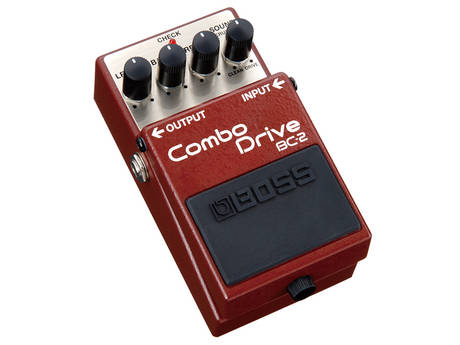
  • Boss Combo Drive
The Bad Monkey has been in my collection from way back.
Its a nice simple pedal that is kind of a Tube Screamer clone.
The results were pleasant and ranged between a little grit to nice full overdrive, which is great for chunking out the power chords.


The Sansamp is one that I had never used with a guitar amp(only direct). I know, ridiculous right?
It was excellent.
Each setting was really usable and not at all fizzy.
Lots of versatility and had a great gentle overdrive, but was not quite the death metal machine that I thought it would be on the high gain settings. Not that it really matters. I haven't played that sort of stuff since 1996.

The Combo Drive is really quite effective at generating Vox-like tones and as I've stated in an earlier article, goes from clean to seriously metal. Its a great little pedal for those looking for a tone change, without the massive investment. They're quite cheap at the moment too.

I felt like a kid in a toy store. Rediscovering distortion was something that I needed to do. Hopefully I'll actually be proactive with making music.

Tuesday, March 6, 2012

2012 - Sansamp GT2 - First impression.

I scored a GT2 this week for a really good price. I'd been humming & hawing about getting one for ages, but since they're usually more than $200AUD for a second hand one, I was reluctant as I do have a few adequate amp & speaker modelers (Bad Monkey, Condor Cab Sim, Digiverb, VT Bass).

I got mine nice and cheap and have only had a little while to play with it so far, but already there are things I do and don't like.

Here are the basics:
3 amp settings (Tweed (Bassman), British (Marshall), California (Boogie).
3 "mod settings" Clean, Hi Gain & hotwired.
3 mic settings Classic (flat), Center (mids), off axis (lower mids)

First off the amp settings appear to have different gain and eq structures, the Tweed being the lowest gain and the California being the highest. The tweed has the lowest bottom end and the others are fairly similar in my first test.

The mod settings appear to be a little misleading, as the "clean" setting doesn't mean clean tone, but actually means "stock" or "unmodded". I have read on other websites that the Sansamp is not capable of a clean boost, this was not my experience. When set for Tweed, Clean & Classic, I was able to get a really nice Fenderesqe clean tone with my Goldtone PB-GRE. As mentioned in my previous blog article, this guitar has a fairly low output and is likely biasing my experience.

The tone of the settings I've described is sparkly top with a nice thick bottom. I did notice a bit of noise (hiss), but that might be due to a flat battery, or that I'd cranked the gain. After fiddling with the knobs (they're old and a bit crackly) I was able to tame the noise and stop my mixer from overloading.

Speaking of overloading, this and the VT bass have some serious power in the output department.
It can be tricky to track down the culprit when your mixer clip light isn't triggered and there's unwanted distortion somewhere. I'm not 100% on this, but I think that the Sansamp series might actually be able to clip their own output stage.

So far I'm not convinced that the high gain models are up to the job of direct recording without some intermediary speaker cab filter. They can be somewhat fizzy, but it's also possible that the low output pickup just doesn't play well with those settings and I need to use a guitar with a humbucker or at the least high output single coil, like a P90 or a Mosrite.

I'm pretty happy with the clean tone and look forward to spending more time with the unit.

Stay tuned.

Tuesday, December 6, 2011

2011 - Initial Pedal Reviews

I've got my hands on two pretty nifty pedals recently, I was a bit dubious of their claims, but it turns out they're quite pleasing to the ear.

The pedals I'm talking about are the Tech 21 VT Bass and the Boss BC-2 Combo Drive. I have been after a decent bass sound for years, but only play occasionally and have no desire for an amp. I've played around with a couple of VST plugins that emulate some well known bass amps, but have never really been satisfied with anything aside from the clean tones.

I'd been looking at a bunch of solutions for going direct, including the Digitech Bass Squeeze, as it has speaker modeling. Unfortunately I couldn't find one in store anywhere, so I never got it.

I'd been impressed by the Sansamp products in the past, so I decided to find out what was available these days. This is how I came across the VT Bass. Demos of the clean sound were scarce, but the reviews were glowing. I figured that if I found one at a reasonable price, it would be mine. I have to say, I wasn't disappointed. As soon as I plugged it in, I was greeted by a thick warm sounding bass. I fiddled about with the settings card and got some nice tones, though all were dirty.

The sound that I was after was the sound of an Ampeg SVT fridge setup. Low and clean and huge.
Tech 21's pedal really delivers in this regard. I get what I want, without spending $4000 on an amp.
Sure it's not a magic box, but it gets me the tone that I want without much fuss or an eviction notice.

Since I have to do most of my guitar playing with headphones I have been messing around with direct solutions for years. The Digitech Bad Monkey is consistently the last item in the signal chain before the mixer.
I like the tone of the built in cabinet simulator. The only down side is that the bad monkey doesn't do clean, even on the lowest setting. I'd seen that the Boss BC-2 had just been released in Oz and was pretty cheap.
The demo video below sounded pretty good so I picked it up on a whim. Got it home and was able to mess with it for about an hour. Combined with the Bad Monkey it's quite dark sounding compared tot he sound in the video and as such it doesn't exactly sound like the Beatles, but it does a nice clean boost on one side and really heavy distortion on the other. The EQ is nice and makes up for the lack of bottom end in my Surfcaster.

My favourite setting was with the Treble on max, Bass at 75% and the "sound" at 25%. This allows for some grit when picking really hard or nice thick clean when playing gently. I even plugged  it into my Fender Princeton and found that there was something missing when switched off.

I hope to get some demos recorded soon, but my computer is in need of a rebuild as it's spitting the dummy every time I try to get some sound on disc. Meanwhile, check out the videos from Youtube.


Sunday, July 3, 2011

July 2011 Pedal Gallery

My neighbour told me that I've been neglecting the blog of late, so I've just taken a few happy snaps of the pedals that I keep under my desk. This is most of my current working collection. I've built loads more than I have here at the moment and have discovered Circuit Snippets to be a great collection of unusual circuits for processing audio. Whoever the guy is behind it, must be some kind of genius!

Not much has been going on, trying to get motivated to finish my pickup ring templates, and in turn finish modding my Les Paul.

Home made fuzz pedal - A blend of a failed Ampeg scrambler followed by two cascading Germanium Transistor boosters.

Fuzz face clone - Easy face with tone control - Substituted Soviet era transistors for recommended.

Psychtar - From circuit snippets.

DOD stereo chorus - With vibrato mod (my design).

Bronx Cheer - Another pedal from Circuit Snippets

Ibanez  DE7 - Cheap good sounding delay.

Zoom H4n - Not a pedal, but has loads of FX. Good as a Rocktron substitute.

Danelectro Cool Cat Chorus - 18v model. Yard sale bargain.

MXR Blue Box - Two octaves down with lots of fuzz - Great square wave tones.

Fuzz Face Clone - Another fuzz face clone - Soviet GT404 Germanium Transistors. Volume control only.

Belcat Tremolo - Nice cheap variable wave shape tremolo.

Boss SD-1 - Modded clipping stage - Can't remember which mod...

Digitech Bad Monkey - One has been modded to let more bass through - Can't remember the cap value, probably .1uf

Sovtek Big Muff Pie - Indie rock staple. Fuzz Fuzz Fuzz. Works best with low output pickups.

Sovtek Small Stone Phaser - Nice sounding phaser, but has a tendency to generate nasty clipping on the front end if modded to compensate for the volume drop.

Fulltone DejaVibe - Nice Univibe clone. A bit expensive, but worth checking out.

Jim Dunlop Octavio - Fuzz Octave - Unpredictable insane fuzz. Very pronounced octave effect. Sounds different on every guitar.
Legacy OC-100 - Boss OC-2 clone - Might be cheap, but it tracks as well as any pedal. Works great with my stereo flying v!

Tuesday, October 26, 2010

2010 - Boss SD-1

This one came to me nice n' cheap. I bought it at a 2nd hand dealer in the city. $65 and practically brand new.
What do you do with cheap pedals? Mod them of course!

I'd read that this is basically a tube screamer with some parts changes.

Stock this pedal is pretty decent sounding, a moderate overdrive on full and a nice clean boost on minimum.
Unfortunately the filter caps on the input remove a lot of bottom end. So rather than add some punch, it cuts some of the guts out of it.

The first thing I did was to do the SD808 mod and turn it into a tube screamer.
Basically it's just changing one cap, removing another as well as a diode in the clipping stage.
What this does is make the clipping asymmetrical and alter the tone control.
To my ears and playing style, it wasn't much of an improvement. It still lacked the bottom end.

The next mod I did was the bass mod.
This is done by simply bridging two components, a capacitor and a resistor.
It was three weeks before I got around to testing it out, but when I did, the pedal was a whole new beast.
The gain still isn't much really, but that's OK I like it like that. The bottom end is nice and big, though a little muddy as there's a slight octave effect on some notes. But for the tone I'm after, this is almost perfect.
Placed in the FX loop of the Delta Blues, the pedal is responsive to dynamics and has the added bonus of acting as a master volume, though the extra gain from the preamp means that the pedal never completely cleans up.

I may end up doing some further mods to the clipping section and maybe change out the opamp for something else. But for now I'm pretty happy with this cheap pedal that cost about $1 and 15 minutes of my time to get close to what I want out of an overdrive.

Not too smooth, and just a little raspy.

Wednesday, September 29, 2010

2005 - Digitech Bad Monkey

In some circles this pedal is over hyped, in others it's not appreciated.
People seem to think it's just another tube screamer clone. And it is, even though it has adjustable bass and treble, rather than just a tone control.

They're cheap, which is a bonus, they sound good out of the box. Also good, since the components are surface mount and not easily modified. There are some "secret" bass mods out there, but if you're handy with a soldering iron and can do simple R/C calculations, you'll be able to do the mod for yourself.

I have two, mine are stock.
One was made in USA and the other in China.
There are no sonic differences to my ear, but there are some visual differences.
Namely the colour of the capacitors and from memory, the PCB's might be a different colour too (it's been a few years since I opened them up).

The sound of them is a mild overdrive to a very moderate distortion. Two in series is pretty good for a metal distortion tone. The distortion never cleans up completely, so they're not any good as a clean boost.
It could probably be changed, but the traces and parts on the board are tiny and I doubt worth the effort.

Even though this is an overdrive pedal, that's not really what I use it for.
It turns out that Digitech have incorporated into their pedals, a very nice DI, complete with the correct EQ to record the guitar clean or distorted through the "mixer" output. It balances the tone and simulates the reactive load of a speaker. I use it all the time when noodling with my headphones on or recording guitars when I can't mic them up (which is most of the time). Actually I like using the Bad Monkey in bypass mode to act as a buffer and signal splitter, so that I can record the unaltered guitar tone through the desk as well as recording an amp. That way I can change my tone/fx later and if I want to re-amp the signal for re-recording "live" effects.

You should be able to pick up a bad monkey for about $50AU.
While there's nothing ground breaking going on, they offer some very handy tools for the recording guitarist.
I've even used them live when there weren't enough Mic's available for the whole band!