Visits

Friday, December 28, 2012

Xmas Present - Amplitube iRig Guitar Adapter

Amplitube iRig
Between tinkering in the shed and eating too much, I have been playing with my latest music toy.

The guitar adapter thingy from Amplitube.

It's the iRig adapter for iPad & iPhone.

It plugs into the headphone socket, with a pair of sockets on the unit to accommodate your headphones (or line out) and a guitar input.

Garage Band
With the stock Amplitube app the unit works flawlessly. If you've used their VST plugins, you'll know what to expect (I liked their Fender pack so much that I went out and bought a Fender Princeton).

Unfortunately the iRig doesn't work very well with Apple's Garage Band v1.3 Tested on an iPhone 5 (iOS 6.0.1)& a 3rd Generation iPad (iOS 5.1) and it happens on both units.

Garage Band Versions
The problem is that you can't monitor at a decent volume or use any sort of medium to high gain  setting what you are playing without horrible feedback (I've tested the iRig in an iPhone 4s running GB 1.2.1 and do not experience the feedback).

This is a real bummer, because Garage Band is a really nice bit of software.

Rumour has it, that the previous version of the Garage Band software worked just fine.
Hopefully it'll be fixed soon, otherwise it'll just be another FX toy that I don't use much.

*Update:
I've managed to downgrade Garage Band from 1.3 to 1.2.1 on my two iOS devices and the feedback problem has been cured. There is the issue of a "ticking" noise on the iPad, but I don't have this problem on the iPhone 5.

Sunday, September 16, 2012

Ibanez FL-9 Re-Repaired & Misbehaving

I've "fixed" this one before. But it didn't stay fixed.
The LFO wasn't doing much of anything after a few weeks and sat in various places for more than a year awaiting some attention (I really do have too many hobbies).

My shed wasn't freezing and I had some clear space on my bench, so I decided to drag out the soldering iron and tinker for a bit. Not the easiest thing to do, when a small human is intent on using your legs as a storage compartment.

I cleaned the board, touched up some solder and pulled out the opamps.
Just in case this fails again, I decided to add some IC sockets to make it a painless fix in the future.

Anyway it's working again. Probably better than in any time I've owned it.
The trim pots were set from the last time and the flanger is able to self oscillate and do some really annoying noises.

If you share a house with someone who doesn't like the sound of sirens and sci-fi movies, maybe turn the speakers down when you check out the clip below.

FL-9 Test

Tuesday, July 3, 2012

DIY Isolation cab - Revisited

It's been quite a while since I built that little box. It works reasonably well, but could definitely be better.

The box now belongs to a buddy of mine who lives in a small flat. I don't know how much use it's been put to, but it couldn't come with me to the new property.

While reserching methods for building a studio, I realised that I could have done the iso-cab so mch better.

The box was made with 9mm ply, glued to a pine frame and some earth wool was placed inside.
Performance was ok, but it could still be heard and was only any good for a small amp.
I think maybe even the 15 watt Fender Princeton was too hot for it.
Something like a 5 watt Valve Jr, Black Heart, Tiny Terror is more suitable.
This is due to two factors, the size of the cabinet and the density of the walls.

The cabinet I built was basically a 600mm cube. This was due to size restrictions with the flat I was living in.

What I've read is that the small volume of air can lead to speaker and output transformer damage, due to back voltages being generated in the voice coil.
Indeed on one test of a 10" driver, I was alarmed to find that the magnet was quite warm to the touch.
This is not something I have ever noticed before. I stopped that test fairly quickly. Every other test I did was at a lower volume and on a speaker with a larger magnet (better heat dissipation, among other properties).

Despite the small sound however, the sound was pretty good, no "boxiness" was present, but I think that was likely due to the mic being pressed right up against the speaker grille (no room for ambient sound).

A better design would be to double the length of the box, leave out the rock wool (it really did nothing in terms of blocking the sound path), use 18mm ply and a couple of layers of plaster board (with an air gap between the inner and outer layer). Essentially building a tiny version of a room within a room. Plaster boards properties lend itself to be quite the good little insulator. Not what I expected when I started my research.

Making a sound proof box it seems, is entirely dependent on just a few factors. Density, Mechanical Isolation and a Perfect Seal.

That means Thick Walls, Rubber & Air isolation between inner & outer boxes, and Blocking the movement of air through any gaps that may appear during assembly.

Anywhere air goes, sound goes.

Saturday, April 21, 2012

Mystery Hum, Mystery Solved.. I think.

For the past five years I have been plagued buy a mystery hum that gets into every non humbucking coil in the house (Even the reverb coils in my amplifiers). If I wanted to have hum free plating, then I had to orient my guitar in such a way as to reduce induction from the magnetic field lines. The source always stayed in the same place, but I couldn't figure it out.

Two days ago I awoke in the cold dark hours with an epiphany.
There is an electrical substation about 80 meters away, which I have walked past a couple of thousand times.
Until that moment of clarity I never even noticed or made the connection. It's encased in a residential/commercial looking brick building. So no glaringly obvious.

The Awesoem Power Of Rockets is looking forward to the transition to a larger residence where there is space for a small recording studio & workshop. Hopefully no hum in the air!


Thursday, April 19, 2012

Sorry about the lack of updates.
The Awesome Power Of Rockets headquarters are in disarray at the moment.
Preparing to make the transition to larger premises.

That won't take place until mid June, so posts will likely be few between now and July.

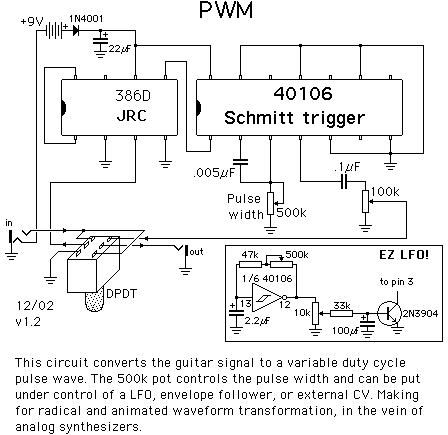
Anyway, to keep it somewhat music related, I highly reccommend that any DIY enthusiasts head over to the circuit snippets archive and check out some really sweet projects.

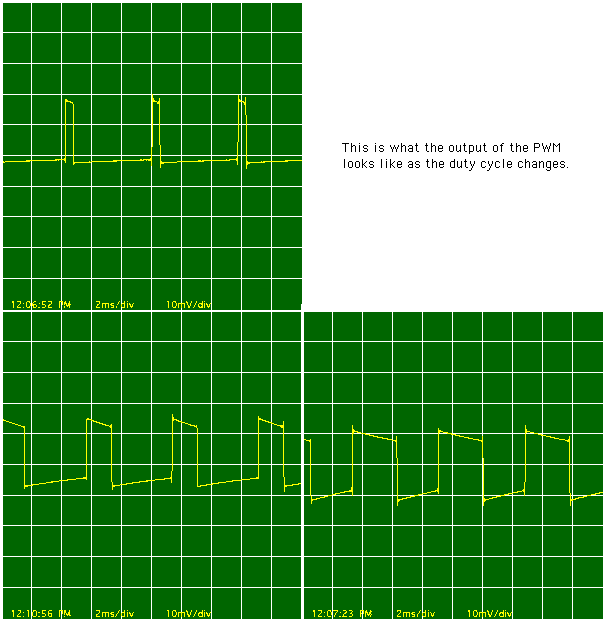
My favourite being the PWM, which sounds a heck of a lot like a big fat mono synth.
It can be controlled by LFO or an expression pedal. Don't be affraid now, the circuit is easy to build and I suspect, designed by a genius!

Check out the Sound Sample


Monday, April 2, 2012

Going Direct

I've not had too much going on in the land of musical instruments.
What precious little time I've had to sit down with the guitar, has been spent tinkering with my various D.I. boxes.

The Sansamp GT2 seems to be the best among them.
I mostly set it for Fender style clean tones with reverb supplied from the Boss FRV-1.
The results are quite satisfying. Like a tube amp in the sweet spot, it will break up pleasantly if pushed hard. I can't say the same for the Digitech digiverb.

I'm not sure if there's a dodgy patch lead or if the pickups of my Mosrite are too hot, but I hear an unpleasant clipping when the reverb is engaged. Bypassed the distorion goes away, but even when fully dry, the clipping is evident, which is a bit of a shame as I like playing with a wide range of dynamics.

The issue requires futher investigation, and comparison against the Bad Monkey pedals from the same manufacturer.

Will get around to posting samples one of these days.

Tuesday, March 6, 2012

2012 - Sansamp GT2 - First impression.

I scored a GT2 this week for a really good price. I'd been humming & hawing about getting one for ages, but since they're usually more than $200AUD for a second hand one, I was reluctant as I do have a few adequate amp & speaker modelers (Bad Monkey, Condor Cab Sim, Digiverb, VT Bass).

I got mine nice and cheap and have only had a little while to play with it so far, but already there are things I do and don't like.

Here are the basics:
3 amp settings (Tweed (Bassman), British (Marshall), California (Boogie).
3 "mod settings" Clean, Hi Gain & hotwired.
3 mic settings Classic (flat), Center (mids), off axis (lower mids)

First off the amp settings appear to have different gain and eq structures, the Tweed being the lowest gain and the California being the highest. The tweed has the lowest bottom end and the others are fairly similar in my first test.

The mod settings appear to be a little misleading, as the "clean" setting doesn't mean clean tone, but actually means "stock" or "unmodded". I have read on other websites that the Sansamp is not capable of a clean boost, this was not my experience. When set for Tweed, Clean & Classic, I was able to get a really nice Fenderesqe clean tone with my Goldtone PB-GRE. As mentioned in my previous blog article, this guitar has a fairly low output and is likely biasing my experience.

The tone of the settings I've described is sparkly top with a nice thick bottom. I did notice a bit of noise (hiss), but that might be due to a flat battery, or that I'd cranked the gain. After fiddling with the knobs (they're old and a bit crackly) I was able to tame the noise and stop my mixer from overloading.

Speaking of overloading, this and the VT bass have some serious power in the output department.
It can be tricky to track down the culprit when your mixer clip light isn't triggered and there's unwanted distortion somewhere. I'm not 100% on this, but I think that the Sansamp series might actually be able to clip their own output stage.

So far I'm not convinced that the high gain models are up to the job of direct recording without some intermediary speaker cab filter. They can be somewhat fizzy, but it's also possible that the low output pickup just doesn't play well with those settings and I need to use a guitar with a humbucker or at the least high output single coil, like a P90 or a Mosrite.

I'm pretty happy with the clean tone and look forward to spending more time with the unit.

Stay tuned.