Visits

Showing posts with label Korg. Show all posts

Tuesday, February 28, 2012

Presenting: The Humble microKorg

This bit of kit seems to have been one of the most popular and derided synthesizers of the last decade.
It's size and price were appealing to the masses, and for many their first synthesizer.
I've had mine sine early 2007, and it was far from my first synth.
Essentially it's a cut down version of the MS2000. In fact, the only real difference is that it's got less knobs.
Out of the box it comes with some of the most cheesy presets I have ever heard.
The presets are grouped on the front panel via genre's surrounding the main selector knob.
Unfortunately the genre's don't sit well with many, and I ended up covering them up with my own printed on stucky labels.

The microKorg appears to be fairly limited on the surface, but below the surface lays the heart of a small modular synth. What it lacks in polyphony, it makes up for in charm and scope for some really useful and just plain weird sounds.

What people need to get past is that it's not analogue. Complaints of a lack of warmth are unwarranted.
Spend a bunch of time with the little beastie and I bet your opinion will change considerably.


I mostly program variations on Electric Piano and Organ sounds, with a few string synths, pads and science fiction noises thrown in. It's capable of some seriously overwhelming Bass, which it turns out is really handy for emulating a church organ. You can achieve a kind of 8 bit vibe with it as well, but it would be better if a bit crushing effect was available. I don't spen too much time on that since I built the Midibox 6582 in 2010.

The modulation matrix is surprisingly flexible and you can rout to most major points which you would want to control.On the front panel you'll find every parameter listed helpfully next to its corresponding number.

Modulation sources are Two LFO's with multiple wave shapes (LFO2 is more limited in selection), Envelope generator, Modulation Wheel.
Cross modulation is possible between sources and you can obviously send them to control pitch & cutoff.
Korg also included control for the audio output, so you're able to do nifty tricks like emulate a lesie speaker by controlling the left/right balance.
Unfortunately what was left out of the control matrix is the ability to control the effects section, which I think is a real shame as they are capable of making things a little crazy.

The vocoder is a fun addition, you have the option of using internal oscillators, or doing the classic thing and using external carrier and modulator waveforms.
Getting the vocoder to sound good is a tough task, but it can be done with some patience and experimentation. I prefer to use external sources over the internal waves as it seems a bit more authentic.

The microKorg also makes a nice effects box.The effects are noise free and whilst basic, sound as good or better than many stand alone units.
Chorus, Flanger, Phaser & Delay are staples for guitar, but if you set it up just right you can use the Arpeggiator to make yourself a midi synced variable patterned tremolo.
Using the filter on guitar allows you to emulate the use of a Wah pedal, with the additional option of midi sync.

Speaking of filters, the digital filter in the microKorg has been designed well. It sounds nice and smooth, and doesn't have the zipper effect which plagued many earlier analogue models.
The filter holds up quite well to it's analogue counterparts eg: MS10/M20, Frostwave Resonator, Moog Ladder filter. It isn't capable of the nice analogue overdrive, but you can fix that with a simple dirt box for very little cash (make your own if you want!).

My only gripes with the design decisions behind this little box are the lack of velocity sensitivity in the keybed and the complete lack of control over the inbuilt distortion (which sounds horrible in my humble opinion).

I've been tempted to sell it a few times, but at the end of the day it's got so many features that I'd be kicking myself if I parted ways with it rashly.
Even compared to more modern synths it holds up nicely and I believe is one of the better purchases I've made over the last fifteen years.

microKorg Manual

Monday, October 10, 2011

Korg MS10 Repairs

Long, long ago. In an ebay auction far far away, I had thought that I would be parting ways with My Korg MS10, as I had with many other bits of music gear before it.
As you will see, this was not to be.

The person who had won the auction, had a mutual aquantance through a certain synthesizer building gang that we were involved in. OK, not a gang, but a bit of a club for nerds.
Synth Nerds. When he came to pickup the synth I was proud to show him many of my recent builds. This included one Music From Outer space "Sound Lab", WSG and partially built modular synth.
I'd also built a stack of pedals and there was all sorts of electronic stuff littering my work area.

We chatted for a bit about whatever, and he played with the MS10. Everything was fine, he paid. We parted ways. But not for long.
By the end of the week, I received a call that the filter knob had stopped working. This was unexpected, as I'd been careful with the synth.
Sure enough, when he brought it back, the filter pot was all jammed up. I opened it up to have a look see, and discovered that the carbon track inside the potentiometer had actually crumbled.
This was a first for me, but since it was 30 years old, I guess it was bound to happen.

The potentiometers in the synth all have long legs at a right angle. They also double as fasteners for the circuit board to attach to the face plate of the synth.
I jimmied up a temporary fix, but needed to order the part from a specialist overseas. I think it was sourced from Small Bear, who have a great selection of uncommon parts.
While waiting for it to arrive, he asked me to add a ring mod to it, as he likes to make lots of weird noises. I ordered a "Real Ring Mod" from Ken stone and the MS10 just happens to have the right output impedance to enable it to work without any extra electronics. Sweet.

Once that was all done, I handed it back to the owner, who was pleased as punch about his synth again.

Some time down the track, it stopped working and it was back on my bench for repair again. I don't remember what the problem was this time, but a fuse had blown and I installed a new one.
Returned to the owner and it was business as usual.

I may have seen it again in the mean time, but in the last week I received a call from him again.
The synth had been dropped, a key was broken, one end smashed and it wouldn't turn on.
I thought the worst. Smashed keys are no fun and I expected to see a severely damaged synth turn up on my bench.

When he brought it in, it didn't look too bad, a bit of plastic from an end cap had broken off, but it could be glued back on.
The other end of the synth was bound in electrical tape and covered the last F key, which turned out to be the broken one.
Indeed, the unit wouldn't turn on. I checked the fuse and power cord. They were ok. Something else was wrong.
What this means, is that to find the problem, I had to disassemble the entire thing!
That involves around 30 screws and a similar amount of nuts. It takes a little while to do, but otherwise no big deal.

With the chassis open, the keyboard needs to be disconnected, which is only connected by a little socket on the side of the board. Easy.
The ground also needs to be disconnected from the base plate. This done, the keybed can be set aside.

With my multimeter set to the appropriate range, I tested the mains side of the transformer for the right voltage coming from the socket (240v in Oz).
This also ensured that the on switch/volume control was working. The next thing to do is to check the output transformer. The voltage range should be between 10 - 20v depending on the tap.
I'd determined that was fine and proceeded to the main board. No damage was evident on the back (solder side) and there was nothing indicating a burned out component on the front.
So first things first, poke around with the voltage probe. Starting at the voltage regulator.

Right away it was obvious that there was no voltage on one of the regulators. Then I poked the middle pin and the LFO lamp flashed to life.
Aha! There was the problem, right in front. First go. Upon closer inspection (I needed my spectacles) there was clear evidence that the middle pin for the regulator had cracked.
It was simple fix. Pull out the cracked pin from the board, put in a single header pin, which has a little plastic collar on it to stop the pin falling through the board.
I soldered the middle pin of the regulator back in place and the electronics were back in business.

The next fix was a simple mechanical repair. The key which had broken, could not have been broken in a better place. All that had happened, was that one of the plastic tabs to keep the key balanced on it's spring was snapped off. The piece that should have been floating around inside, was nowhere to be seen. so I rummaged in my parts bin for some suitable material and I found a piece of perf

A couple of other bits needed to be glued back on. I used some epoxy and it's holding together nicely.

Finally I reassembled the synth and informed the owner that it was good to go.
This message was accompanied with a warning.


Should I ever see the inside of this synthesizer ever again, I would grind it up and eat it sprinkled on my cereal!


The voltage regulator with a crack on the middle pin


Monday, October 4, 2010

2007 - Korg MS10

The MS10 is an under rated synth, though considering the specs, a bit expensive for what you get.
But what you are paying for is a bit of hype dripping from its bigger brother. Don't get me wrong, I love this synth. It oozes bass and the filter makes a brilliant guitar distortion.

Actually if you're after some interesting guitar tones, the MS10 is great for using as a wah and a filtered tremolo!

The thing that makes it nicer than some of the MS20 filters is that, in the MS10 the diode clipping stage is before the filter. In the clones and later model MS20's the clipping section comes after it and the sound is totally different. I A/B'd the MS10 with a Frostwave Resonator. While both sounded good, the distortion on the ms10's filter was more pronounced and aggressive.

What's clipping? That's a fancy name for distortion.

When you distort your instrument through a pedal, more often than not, the tone controls come after the distortion stage. This is for a reason, it generally sounds better that way (not a rule, but it does work nicely).

The oscillators are the typical Korg sound.
My favourite is the Square wave with a bit of Pulse Width Modulation. It adds a stringy pad like bottom end that sounds great on pretty much every synth out there. The MS10 might not have a whole lot of range, but it does it's thing nicely. Not too many parameters to get your head around and it's great for learning how synthesis work. For the most part you don't even need patch leads as the common options are pre routed via the knobs along the front panel.

Mine had some mod on it when I made my purchase, but I can't actually recall what it did.
I ended up changing the mod to enable audio frequencies from the LFO, which in turn allowed a sort of FM synthesis. I also added a 2nd audio output and a Ken Stone passive ring modulator. This came in handy when I was selling it on later down the track.

Mostly I used it for standard basses, leads and the odd laser gun sound. Typically I'd control it via a Frostwave MC-1. Calibrating it was a pain. The MS10 has a tendency to drift off the calibration for the keyboard and the trim pots were overly stiff and would often go back to the pre-adjustment position.

I ended up selling it on ebay. Shortly after selling it, the new owner destroyed the filter cutoff and asked me to fix it. As a result of that repair, I ended up building several other synths and joining a band with him. Incidentally this also led to being exposed to the wonderful world of Man or Astro Man?

As much as I like the MS10, I don't regret passing it on. I still have other synths that do what it does and if I do get nostalgic, I only have to ask to borrow it.


Specifications

    * Polyphony - Monophonic
    * Oscillators - 1 VCO with mixable white/pink noise generator
    * LFO - One LFO w/ multiple waveforms
    * Filter - One lowpass VCF
    * VCA - ADSR with Hold
    * Keyboard - 32 keys
    * Arpeg/Seq - None
    * Control - CV/GATE
    * Date Produced - 1978

Sunday, September 26, 2010

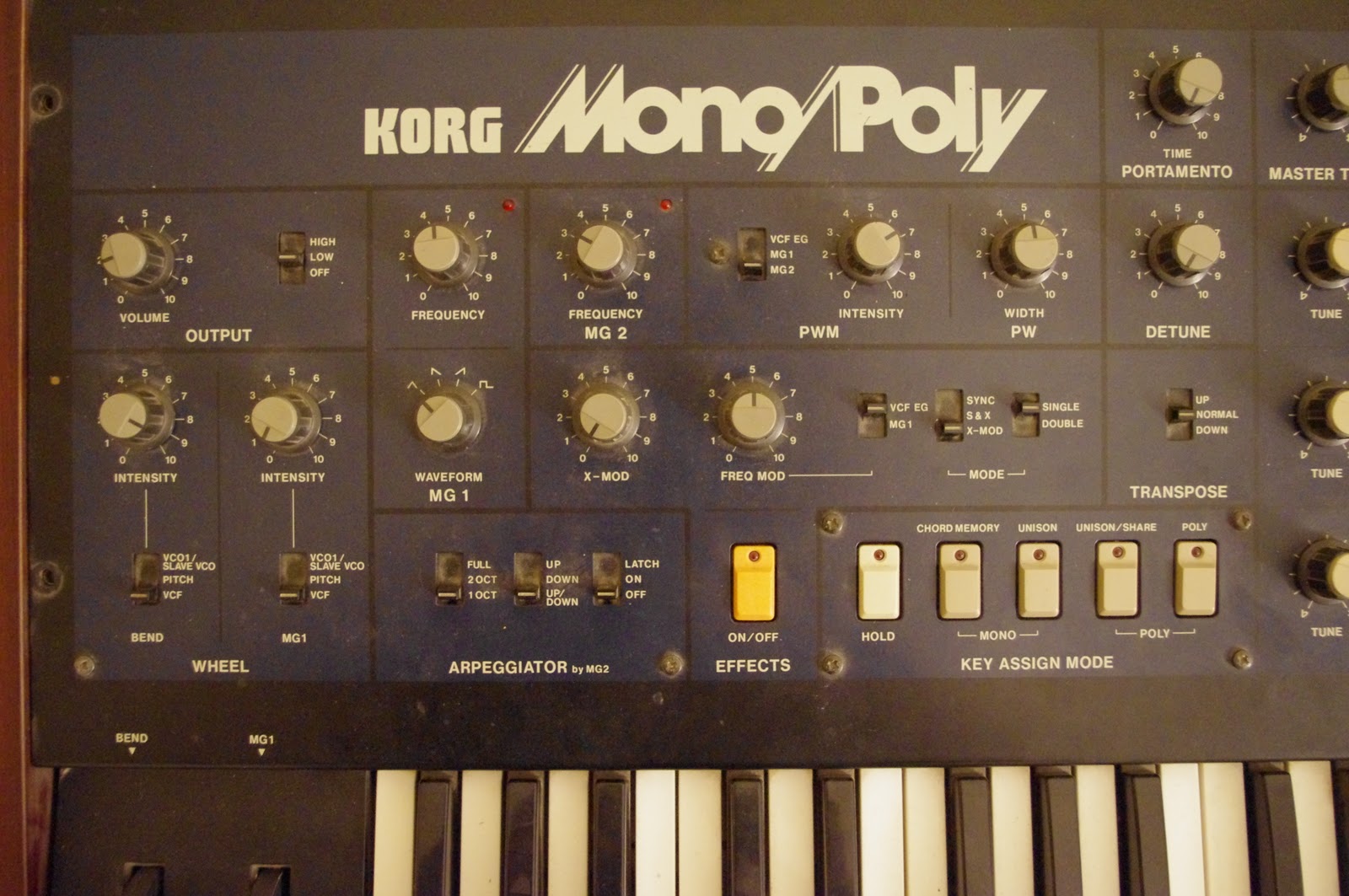
2010 - Korg Mono/Poly

It's mine, all mine, finally mine, mine, mine!

Uh.. yeah. I've been after this synth for a long time.
Not the model, but this actual synth.
When I bought my AN1X it cost me maybe $500.
On the stand next to it was a Korg Mono/Poly for over a grand.
Everywhere I went, online and in meat space, I was told that this synth was not so good.

Well... I thought it looked cool and despite the criticism it's received, I think it sounds great with loads of functions!

This particular unit was found by a friend of a friend at Canberra Tip. That's right, the rubbish dump.
Gut Shot
He was working at the recycling centre at the time and basically had the pick of the stuff that came through before being made into land fill or sold to the public. So it wasn't covered in rubbish and bird poo.
The Mono/Poly was in 100% working order too. Whoever threw it away probably had no idea on how to use it. My buddy had told me the story and I offered a sum of money, but that was rejected flatly.

Sometimes patience pays off.

Portamento Control
A few months ago my old friend came to visit, and I casually mentioned the Mono/Poly again and he told me it was sitting in a cupboard back in Canberra and hadn't been used for years. After a little more conversation it turned out that the owner of the Mono/Poly was into collecting Starwars and Manga paraphernalia. I'd sold off my Starwars Lego, but still had a box full of akira figurines, from back when I was into that stuff.

So we had the basis of a trade. My old house mate was the intermediary and brokered the deal.

The deal was agreed to and a few months later he turned up at my door with a bucket full of old videogame console parts and a rather smelly Korg Mono/Poly.

It smelled like it's been hanging about forgotten, at 9th Ward before it burned down.
There's a smell that every synth I ever worked on gets, when it has been owned by a smoker.
Especially smokers who don't go outside to puff. It's pretty foul, but does tend to go away after a while.

Anyway I got the synth indoors, tried to ignore the smell and plugged in my headphones.

It's a funny old synth. My daughter made her first scifi laser sounds on it at 14 months of age! The portamento seems to be a little off, as in I can't switch it off for each voice. The filter is on a chip as opposed to the MS10 I used to own, which was a sallen key driven by a proprietary OTA style chip. The sound is pretty similar and will self oscillate and has a nice resonance. The poly mode is kinda funny, it can do chords, but not really in the classic sense. 

As yet I haven't had much time to play with it, but I did open it up and take some photos
There are so many knobs, it looks like it'll be a real pain to get in there to clean 'em all and reassemble the board.  Not much dust inside it either, though I found an unidentified piece of hinged metal and a dead moth.

Time to dig out the midi-cv converter and play around.

Thursday, September 23, 2010

2007 - Korg MicroKorg

I know, I know, these synths are everywhere.
Used on loads of albums apparently too(that's what I hear, but have no citations backing me up).
They have a bad rep for the presets being used on these albums as well.
Using factory preset sounds is a pointless waste of an otherwise fun and very useful little synth.
I've had mine for a number of years, and every time I've thought about upgrading or cross grading to other gear, this one never hits the sales room floor.
Why?
Well I have to admit I quite like this little synth.
It's patch panel is excellent and the ability to use the filter, vocoder and fx without having to to use the oscillators is a very handy feature.  It might not be the warmest sounding bit of virtual analogue out there, but it does have oodles of charm.  You can rout almost every parameter to just about everything else.
There are limitations of course. Ideally I'd like to see some control over the built in effects via the LFO & EG section. As there has been an update to the hardware with the XL model, I doubt the MK OS will get a look in.
The first thing I did when I got the synth home, was demo all of the presets.
The second thing I did was erase them. 
When the system is set to default (shift + f3), you get a single saw oscillator.
From there you're open to tweaking to your hearts content. The Sine oscillator allows for some simple FM style synthesis, and is fantastic for playing the Dr who intro or just get creative and modulate as much as you can to just see what happens. The rest of the oscillators have more basic control, and as to be expected the Square had PWM control which makes for great big bass patches.
This synth can do pads quite nicely, though I spent a lot of time programming electric piano and organ type sounds to it. It'll even pretend to be 8bit if you treat it right.
My only beef is the keyboard. The lack of velocity control is a little disappointing (it's available on the ms20 soft synth controller, which has the same keys). Also as there are two synth engines available, having the keyboard splittable and/or at least each voice being controlled via separate midi channels would have been a great bonus for playing live. At least you can do whatever you want with multitracking in this regard.
I've owned a number of korg products over the years and this unit is as well built and capable as any of them.
Each of them had a specific option that I'd have liked implemented, but the lack of options sometimes increases creative opportunities.
The MicroKorg is a great synth and at around $500AU 2nd hand is well worth the money.